

What is regenerative agriculture?
Regenerative agriculture is a land management approach that attempts to work with nature to restore and improve ecosystem health and, in particular, soil health. In this system, crops and animals are managed in a way that attempts to more closely mimic ecosystems in the wild. The focus is on restoring and improving soil health, ecosystem function and biodiversity while still producing food. Regenerative farming relies on a few core principles; firstly soil health is the foundation and the emphasis is on building up organic matter and supporting soil biology. Also, by using a diverse range of pasture species and having living roots in the soil year-round, the soil is never bare. Promoting biodiversity is another core principle, the use of mixed grasses, herbs and legumes encourages insects and birds in the wider ecosystems. Grazing animals must also be carefully managed with livestock being used in a way that stimulates plant growth, cycles nutrients and improves the structure of pasture meaning improvement of both above ground plant community and below ground soil environment. The final core principle is that a regenerative system is less reliant on inputs such as synthetic fertilisers and herbicides and more reliant on natural cycles.
Where would horses fit into a regenerative system?
Grazing animals can be used as a tool to manage land by eating certain plants, trampling vegetation and returning nutrients through manure. When managed correctly this stimulates plant growth, improves soil health and supports a more diverse resilient eco system. At a practical level when grazers eat plants, the removal of the leaf area stimulates plants to regrow and trampling pushes plant material onto the soil surface breaking up dead matter and acting like a natural mulch system. Manure and urine contain nutrients such as nitrogen, phosphorus and organic matter which feeds the microbes in the soil and encourages the nutrients cycles. Finally, a freer movement across the land prevents overuse in a single area and creates variation in grazing pasture.
Horses are often overlooked in the regenerative discussion but they can also play a role if managed correctly. To get a better idea of how, we first need to understand how different animals graze differently and the effect this has on pasture. The main factors that have an influence and drive ecosystem outcomes, include diet preference (grass vs herbs vs browse), grazing height, selectivity, movement patterns and impact on soil (hooves, trampling). If we look at the horse specifically, they are highly selective grazers picking the best plants and they graze very short in preferred areas and will avoid dung which creates uneven grazing “roughs”. This can create overgrazed areas with under grazed rough areas; horses also trample the soil at a moderate level returning nutrients into the soil unevenly as dung is concentrated in patches. The ecological role they play in nature would be creating structural diversity through variation in sward hight. Even though on its own this is not ideal, it can still contribute to pasture diversity and help maintain varied sward structure.
Horses are not ideal regenerative livestock compared to cattle as they overgraze preferred species, don’t evenly distribute manure and can damage pasture in wet conditions. In typical horse management, paddocks are overgrazed, there is set stocking, high reliance on bought in feeds and poor pasture recovery. However, through rotational grazing, rest periods for pasture, lower stocking density and better use of forage, horse-based pasture management can align more closely with the regenerative model.
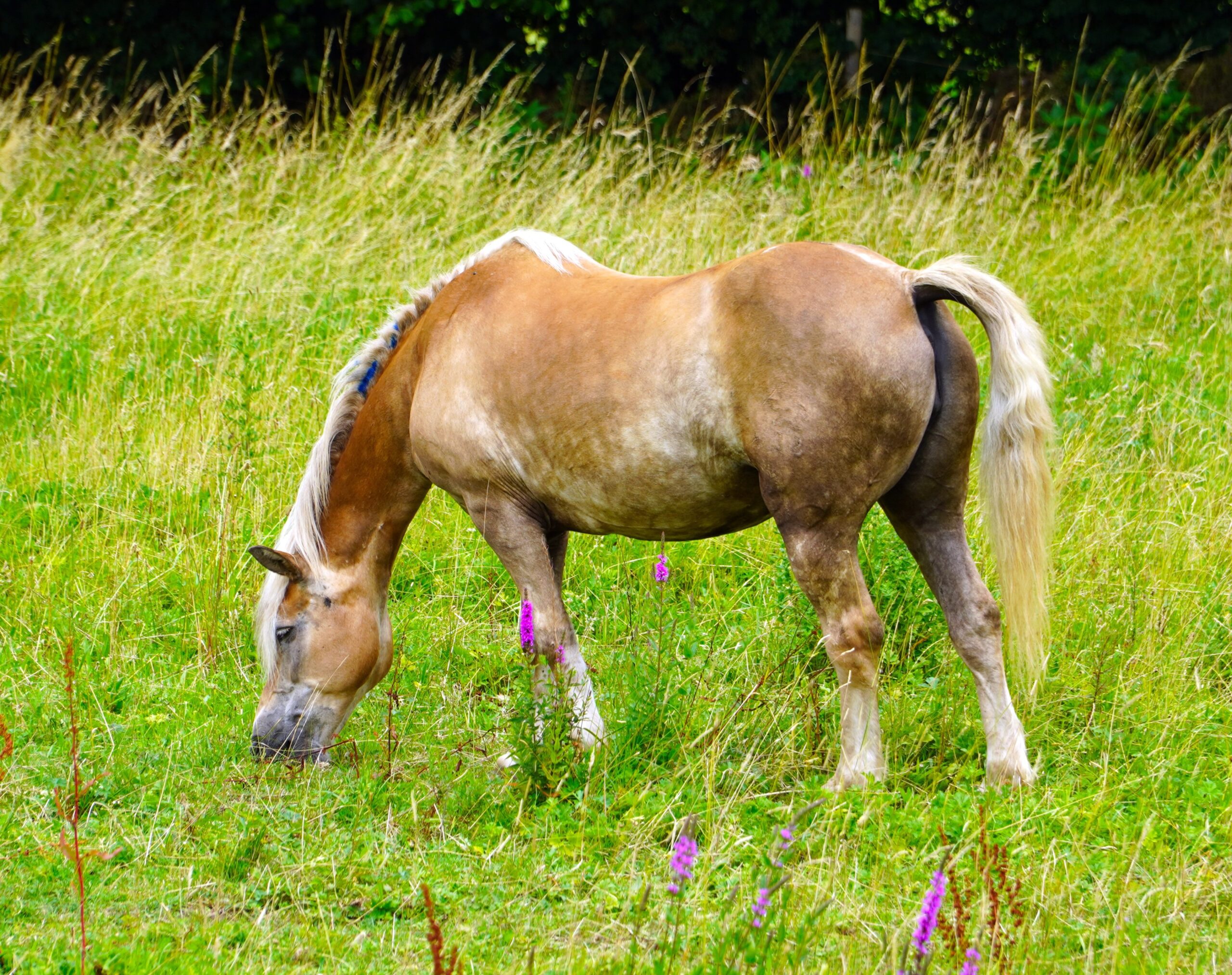
Improving management practices
Rotational grazing (foundation)
The land should be divided into paddocks with horses moved frequently. allowing rest time for paddocks. This prevents repeated overgrazing of the same plants allowing root recovery and regrowth and maintains plant energy reserves. The stronger root systems, will lead to more photosynthesis and improved soil carbon input. As a practical guide to this the land can be divided into 4-8 paddocks and horses moved every 2-5 days. Rate of recovery of pasture depends on a few different factors such as the season and weather and these will determine the rate in which horses can be rotated. As a rule of thumb, move the horse before grass is reduced in height to 5-7 cm and don’t return horses to this pasture until the grass has reached approximately 15-25cms. In winter when there is little growth and damage to fields is high, a paddock can be ‘sacrificed’ i.e during wet conditions , horses are kept in one area and the damage is contained, preventing whole field poaching and the more general loss of grass cover.
Stocking density control
Stocking density control is matching the number of animals to land capacity, overstocking leads too bare soil, compaction, weed invasion whereas correct stocking maintains ground cover and supports continuous plant growth. As a general guide, for an average pasture, 1.5-2 acres per horse (500kg) is usually acceptable with the quality and regrowth of the pasture being the biggest influence on this.
Mixed species grazing (if possible)
Mixed species grazing is the practice of grazing horses alongside other livestock such as cattle and sheep. This practice can be used to encourage different grazing patterns, improve paster use, reduce selective overgrazing and break parasite cycles. This helps create more uniform pasture and greater biodiversity. However, for a lot of horse owners this may be difficult to implement as they may not have access to other livestock animals.
Pasture management
Horses dung is often in patches and not evenly distributed. Ideally pastures should be managed by ‘poo picking’ and redistributing nutrients, when possible, through harrowing. Poo picking still has its place in a regenerative system, however it is used strategically and not necessarily routinely. It facilitates nutrient recycling, parasite management and ‘spreads out’ grazing. Poo picking is recommended in areas of small acreage/high stocking density due to high parasite pressure, limited rest periods and uneven grazing. In a well-managed rotational grazing system manure can be left in place as UV light, time and soil biology can be left to handle the breakdown back into soil. A more ‘hands on’ approach would be to reduce poo picking during spring and summer, using rational grazing and occasional harrowing if conditions allow for it. During winter, the dung in stables and sacrifice paddocks can be collected and left somewhere onsite to compost. This allows for it to be spread onto paddocks later. Ideally The best time to spread manure back on paddocks is when soil and plants can actively use it. The primary windows for this would be in Spring around March-May, when grass is actively growing and nutrients are used immediately. Also at this time soil biota are becoming more active and there is good microbial activity resulting in efficient nutrient cycling and strong pasture response. A secondary window would be early Autumn (September – October) as around this time the soil is still warm, some grass growth remains and there is still good microbial activity in the soil. This helps build soil structure and quality going into winter. It is always advisable to spread manure at a time when when horses are not grazing in the paddock.
Minimise external inputs (where possible)
Reducing reliance on bagged feeds and fertilisers can be achieved through better forage use and matching horse type to land. Overall this overall helps to create a more self-sustaining system and lowers the environmental impact.
Conclusion
In regenerative systems, horses are managed through controlled grazing and nutrient cycling to support healthier soil, better pasture, and more sustainable land use.