

Feeding Your Horse – the Basics
There are many different types of feeds that can be fed to a horse and many commercial feeds on the market that often blend many different feed ingredients together. This can make choosing feeds for your horse a much more complicated and sometimes more expensive procedure. In this article we will attempt to go through some of the most basic feeds that can be used to make up a ration, By breaking down the fundamental components of a horse’s diet—from forage and grains to essential supplements—you can gain the confidence to build a balanced ration that meets your horse’s specific needs without overcomplicating your routine or your budget.
Forage
Forage is always the foundation of any horse diet, providing essential fibre for gut health and providing the horse’s main energy source, Fresh pasture is always the most natural source of energy, nutrients and fibre whereas hay (essentially dried grass!) and is used when pasture is limited. Haylage is partially dried, wrapped forage with higher nutritional value and moisture content than hay and, finally chaff. is a short-chopped fibre (often alfalfa or straw) used to slow down eating or bulk out ‘bucket’ feeds. By slowing down and forcing the horse to chew their food it helps produce saliva which buffers stomach acid and slows down passage through the digestive tract helping prevent colic.
Alfalfa
Alfalfa is a legume and is primarily used as a fibre-based protein source that also provides moderate slow-release energy, and it is one of the most useful “dual purpose” feeds when used in a rationing system. It provides good quality protein high in lysine, highly digestible fibre and is naturally high in calcium. Some of its primary uses include supporting muscle and topline (adding more muscle mass), adding safe calories without excess starch while also balancing forage-based diets as it can be used as both a forage and a protein supply at the same time. It is usually fed as hay but can also be fed in a chopped or pelleted form to add to help slow the uptake of bucketed foods. It does this by encouraging chewing and reducing bolting. It is naturally high in calcium and helps to buffer stomach acid and so is useful in horses prone to gastric ulcer syndrome. Alfafa is usually a good option if you want to improve condition and increase protein without increasing starch and sugars. It is useful when forage quality is low and can be used as a base item to feed performance horses.
Alfafa is generally not suitable for ‘good doers’ as it may increase calorie intake. Also, caution must also be taken due to its high calcium content if fed in excess. This is particularly a problem if phosphorus intake in low. The ratio of calcium to phosphorus should be between 1:1 and 2:1 and excess calcium inhibits the absorption of phosphorus. Alfalfa contains anywhere from 4:1 to 15:1 and an excess of 6:1 calcium to phosphorus is when problems can occur. Therefore when feeding Alfalfa it is important to ensure that there is an adequate source of phosphorus in the diet. This can be done by mixing with grass hay or adding some feeds with phosphorus like oats or some specific mineral supplements however however care must be taken as horses can tolerate high calcium far better than high phosphorus.
Oats
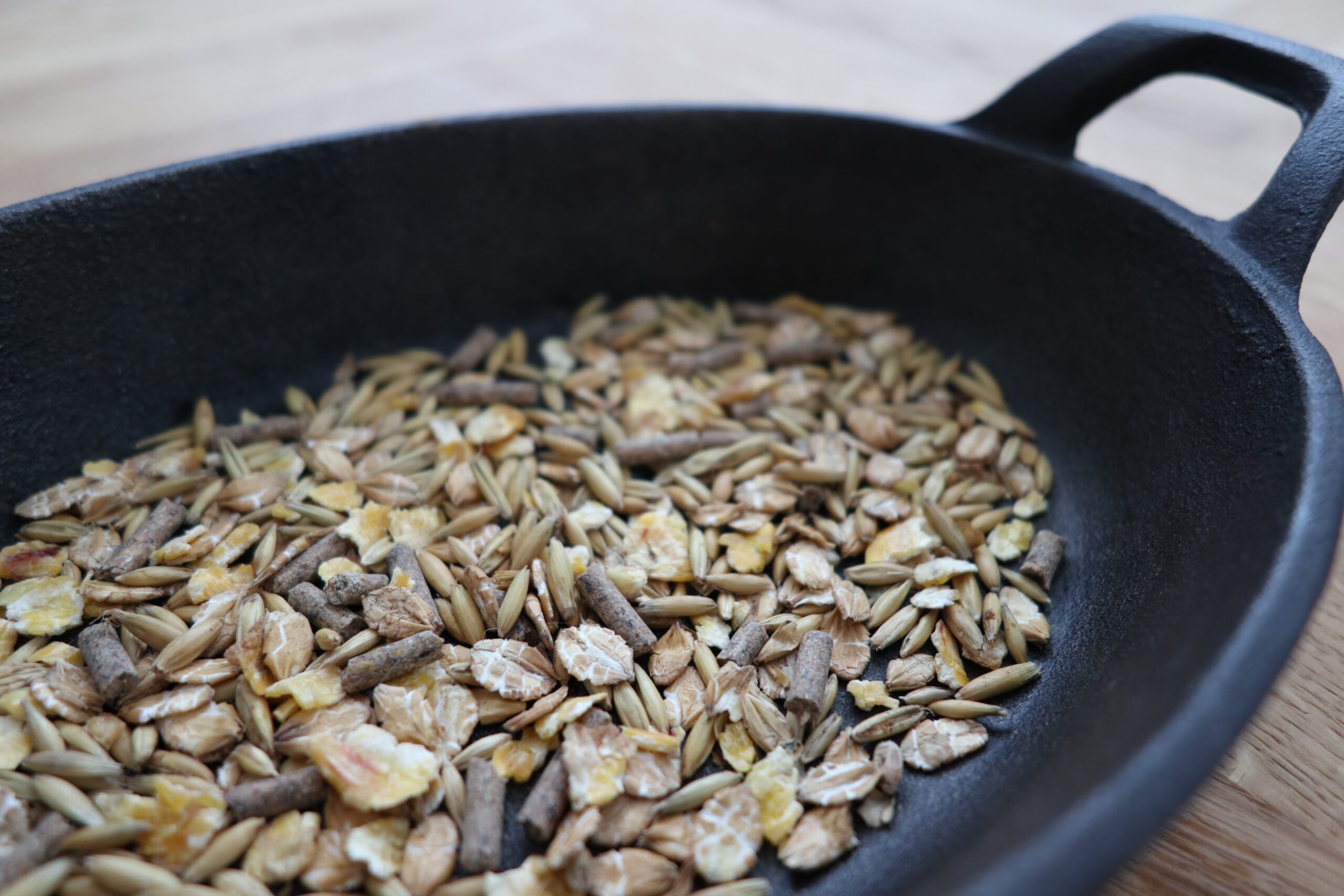
Oats are primarily used as a rapidly available energy source for horses with a higher energy demand and are the simplest and most traditional cereal grain used in equine feeding. Oats provide high starch and quick glucose availability and are readily digestible compared to other cereals. Oats are normally used for performance horses in moderate to high work and situations needing immediately accessible energy. Oats are generally used in preference to other cereals due to having a higher fibre content, lower starch density and a ‘safer’ digestibility profile. However even though oats can be considered less risky they are still a cereal and must not be fed in large amounts due to their high starch content. Oats are often used as a performance fuel and provides energy that fibre and fat alone may not supply quickly enough. Oats are best used in specific cases where weight gain is needed , often for ‘poor doers’ needing extra calories quickly. however only after fibre and fat sources have been fully utilised first. Oats are obviously a widely available food source and minimal processing is required.
Beet pulp
Beet pulp sits between forage and concentrates as an energy source. It provides a high digestible energy while also being low in starch and sugar (when unmolassed). This makes it ideal for weight gain, maintaining condition without excitability and also useful for horses which cannot tolerate starch. Beet pulp also acts as a forage replacer/ extender and can be used to partially replace poor quality forage or in situations where it is limited such as when horses are stabled for long periods. It can be especially useful when soaked as it can increase water intake in winter. Beet pulp is primarily fermented in the hindgut where it produces volatile fatty acids which benefits microbiome stability, fibre digestion and reduced digestive upset – especially when compared to cereals. Lastly, beet pulp can be used as a ideal carrier feed for minerals, supplements and salt.
Soybean Meal
Soybean meal is primarily used as a high-quality protein source with an excellent amino acid profile – especially lysine which is often the first limiting amino acid. This makes it an ideal feed for supporting muscle damage and repair, correcting low protein forage diets and balancing rations where calories are adequate but relatively low. Compared to most feeds it is much higher in protein density and much more precise than alfalfa when targeting deficiencies. This means that a small ‘inclusion’ rate can have a big impact. An example where soybean meal is appropriate could be in balancing out poor-quality, low protein hay (particularly lacking lysine) when small amounts of soybean can help correct the entire ration. It can be particularly useful for supporting muscle and topline for horses in work, young/growing horses and horses lacking muscle despite having adequate calories. Another advantage is that it can be used to improve protein intake without adding excessive calories and therefore surplus energy. Soybean may not be necessary if horses are already on a high-quality forage, perhaps with alfalfa or horse kept for leisure where meeting nutritional requirements is easier. It must always be remembered that more protein is not always better as excess leads to problems such excretion of urea leading to high ammonia levels in stalls, metabolic strain, increased water intake and increased internal body heat. It is therefore important to feed high protein feeds, such as soybean meal, only when they are really required.
Fats
Fats in the diet are used as a concentrated slow-release energy source and a way to support condition without relying on starch. They provide “cool” calories which is a term used to describe calories without the metabolic effects and behavioural effects of high starch cereals. Fat can be added to the feed in the form of oil with some oils being of higher quality than others. Linseed (flaxseed) is considered the gold standard being high in omega 3 fatty acids and some quality protein. The reason omega 3 fatty acid content is significant is because unlike omega 6 fatty acids they have an anti-inflammatory effect promoting reduced inflammation, improved joint health, enhanced coat condition also supporting immune resilience, hoof quality and cognitive health. This counteracts the pro inflammatory effects of omega 6s which a lot of modern horse diets contain an imbalance off as they are found in a lot of grains and cheaper oils. The other option available are common vegetable oils such as rapeseed oil, sunflower oil and soybean oil. These oils can be useful as they are cheap, easily accessible and a very dense energy source. They can be useful for increasing calorie intake quickly, performance horses and for poor doers with the primary disadvantages being the fact they contain no fibre and are high in omega 6 fatty acids responsible for inflammation especially without omega 6 fatty acids to balance them out. Another noteworthy mention is rice bran oil which is also cheap and high in calories but also contains some fibre and phosphorus.