

From Soil to Stable: The Role of Regenerative Forage and feeds in Sustainable UK Equine Nutrition
The modern British equestrian faces a dual challenge: maintaining the peak physiological health of an elite herbivore while minimizing the environmental footprint of its diet. As the UK agricultural sector pivots toward regenerative systems, the focus of equine nutrition is shifting away from energy-intensive, imported cereals and toward locally sourced ‘super-fibers.’ By leveraging traditional crops like Sainfoin, co-products of the British sugar industry like Beet Pulp, and the anti-inflammatory properties of UK-grown Linseed, horse owners can support a nutritional model that restores soil health, promotes biodiversity, and significantly reduces transport miles. This transition represents more than a change in feed; it is a move toward a circular equestrian economy that aligns animal welfare with the ecological restoration of the British countryside.
To get a better understanding of sustainable Equine nutrition we first need to understand the Key principles of regenerative crop growing. Regenerative farming restores soil health by replacing deep ploughing with low-disturbance, no-till methods that preserve the microbiome, prevent carbon loss, and protect the soil’s structural integrity. By keeping the soil covered, maintaining year-round living roots, increasing crop diversity, and integrating livestock, this approach fosters a robust, natural ecosystem that enhances fertility, suppresses pests, and reduces dependence on synthetic inputs.
Examples of Regenerative friendly forages and feeds for equines
With these principles in mind, we can move onto identifying some of the more ecofriendly forages and feeds for horses and why this is the case.
Alfalfa
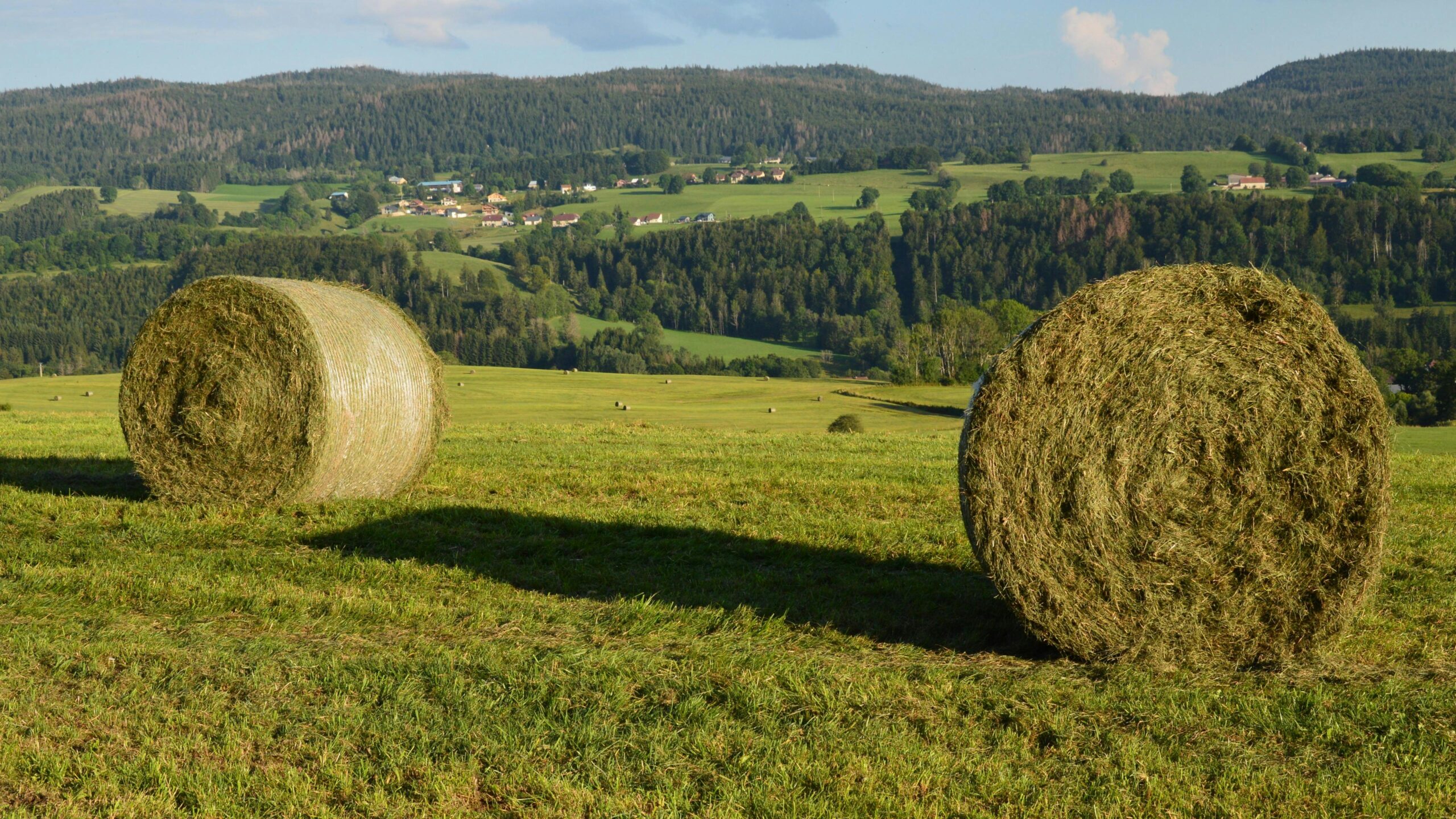
Alfalfa (also known as Lucerne) is a cornerstone of regenerative farming and a highly versatile feed for horses. The reason for this is because it is a perennial legume that can remain in the soil for four to five years. This stability allows it to restore soil health in ways annual crops cannot. It can have a natural nitrogen fixation effect forming a symbiotic relationship with Rhizobia bacteria in its root nodules, which converts atmospheric nitrogen into a form the plant can use. This eliminates the need for energy-intensive synthetic nitrogen fertilizers. Alfalfa roots can reach depths of up to three to six meters (10–20 feet). These deep roots draw up sub-surface minerals, break up compacted soil layers, and deposit carbon deep underground where it is more stable. Also, because alfalfa is a perennial, it provides year-round living roots and ground cover, and This protects the soil from erosion and provides a stable habitat for beneficial insects and soil organisms. Because of this Alfalfa can be grown as a long term (4-5 year) crop rather than an annual crop with the process prioritizing and restoring soil health and can act as a break crop being rotated with more nitrogen hungry crops like brassicas or cereals.
Linseed (flaxseed)
Linseed is another prime example of a horse feed that is both UK-based and highly compatible with regenerative farming. It is a traditional British crop that has seen a resurgence due to its low environmental impact and soil-building properties. It has two main properties, firstly it enhances soil biology; unlike many other crops, it forms a relationship with relationship with a “arbuscular mycorrhizal fungi (AMF)” in the soil which are fungi which are crucial for soil carbon storage and help following crops, like wheat, access nutrients more effectively. It also has a dense, fibrous root system which is beneficial because it provides excellent soil conditioning and this helps improve soil structure and integrity which makes it an ideal crop for “direct drilling” (no-till) systems, which avoid the carbon release associated with ploughing. Linseed can also be grown with significantly less pesticides and fertilizers compared to other break crops like oilseed rape. It is also highly resilient to UK pests. As well as this, it offers a valuable source of both omega 3s and quality protein for horses.
Unmolassed Sugar Beet Pulp
Unmolassed sugar beet pulp is widely considered one of the most environmentally efficient feeds in the UK as it is a circular co-product of the British sugar industry. lowest environmental impacts of any global region, effectively utilizing material that remains after sugar extraction. In a regenerative agricultural setting, sugar beet serves as a critical break crop in arable rotations, helping to disrupt pest and disease cycles and reducing the reliance on synthetic pesticides. The crop’s deep taproots, reaching up to two metres, improve soil structure and water infiltration. Furthermore, after the roots are harvested, the leftover foliage—known as “tops”—is often returned to the land, restoring organic matter and nitrogen to the soil for following crops. Nutritionally, beet pulp is hailed as a “super-fibre” for horses; it is significantly more digestible than hay and provides a safe, slow-release energy source that supports a healthy hindgut microbiome without the “heating” effects of cereal grains.
Conclusion
In conclusion, the transition toward Alfalfa, Linseed, and Beet Pulp represents a significant step toward a more sustainable British equestrian industry. By prioritising these locally sourced, regenerative feeds, horse owners can move away from energy-intensive, imported cereals and toward a system that actively restores soil health and biodiversity.